


Yarn Out 3D
4.7453.00 Reviews
App Specs
- Version
- 1.5
- Updated On
- License
- Free
- Downloads
- 100,000+
- Developer
- Unico Studio
- Categories
- Puzzle
- Platform
- Android
Screenshots
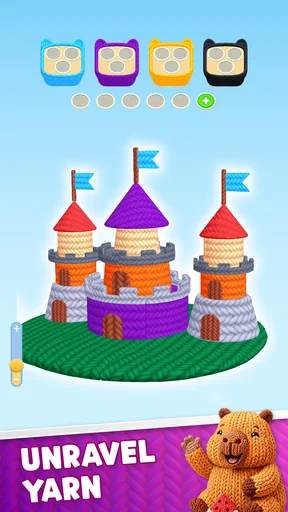
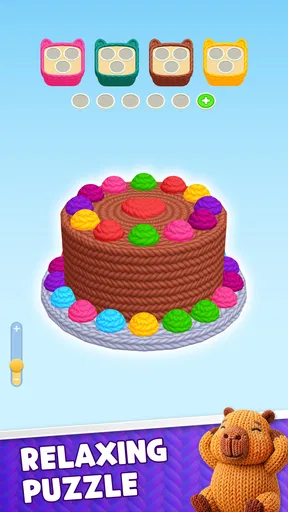
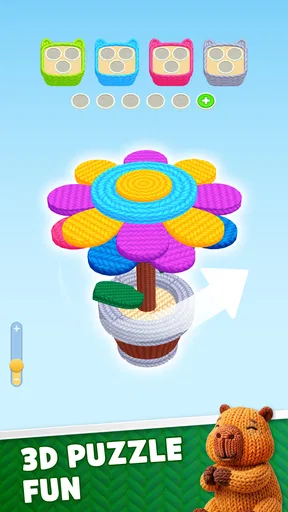

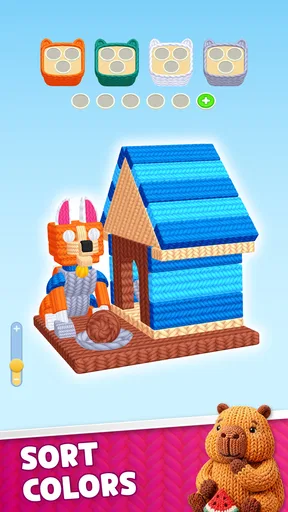
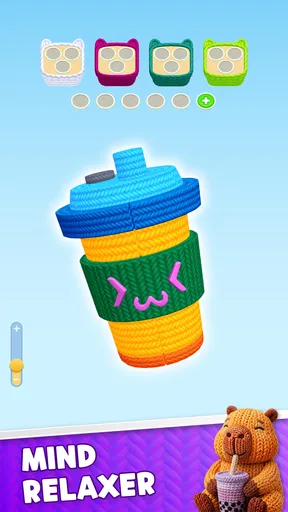
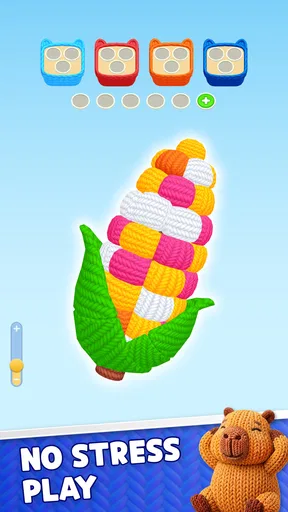

 Analysis by AppCompare
I did not expect a yarn puzzle to be such an effective little break, but Yarn Out 3D quickly made sense as a game for the moments when I have only a few minutes to spare. Its basic idea is easy to understand: untangle and release wool loops in a three-dimensional puzzle space. The appeal is not a complicated story or a long-term collection system. It is the small satisfaction of looking at a messy arrangement, spotting the right first move, and gradually turning confusion into order.
That simplicity is exactly why I can imagine recommending it to someone who wants a calm puzzle rather than a demanding game. I played it with the mindset I use for short mobile sessions: open it, solve something, stop when real life interrupts, and return later without needing a lengthy explanation. The game comes from Unico Studio, is free to start, and is listed for Everyone. Its current version is 1.2 and it runs on Android devices using Android 7.0 or later, which makes it approachable for people who are not using a recent phone.
The important question, though, is not whether the concept sounds pleasant. It is whether the puzzles remain enjoyable after the first few satisfying tangles. My experience is that the game works best when I treat it as a focused snack: a few levels, a little visual problem-solving, and then a natural stopping point. It is less convincing as a game I would play continuously for a long evening.
Why the first few puzzles feel immediately satisfying
The strongest part of the design is the instant readability. I do not have to learn a fictional world, remember character abilities, or understand a long set of rules before making progress. The yarn arrangement itself presents the problem. I look for loops that appear free, consider what may be blocking them, and try to remove them in an order that opens the rest of the structure.
That creates a useful balance between visual calm and mental effort. The wool theme makes the board feel softer than a traditional tile or number puzzle, but the underlying task still asks me to reason about space, obstruction, and sequence. A move that looks harmless can leave another loop trapped, so rushing is not always the quickest way forward. I found myself slowing down naturally, especially when several strands appeared to overlap from the same angle.
The best early habit is to study the whole arrangement before touching the most obvious loop. In a three-dimensional puzzle, the first visible option is not automatically the best one. I get better results by checking which strand seems to have the clearest exit, then asking what that move will expose. This turns each level into a small planning exercise instead of a series of random taps.
That advice matters because the game’s pleasure comes from understanding the arrangement, not merely from clearing it. When I make a lucky move, the result is pleasant but forgettable. When I identify the dependency between two or three loops, the solution feels earned. This is where the title separates itself from very basic matching games: the object is not just to find identical pieces, but to read a physical-looking knot of choices.
Worth Reading Before You Choose

Flipboard Shows What News Apps Must Do Beyond the Feed

Switching to Android Auto Means Rethinking Your Driving Routine

Google Calendar Makes a Crowded Week Easier to Manage

Ludo King Makes the Most of the Minutes Between Plans

Baby Panda World Brings Quick Play to Modern Phones, but Its Game Library Feels Busy

ESPN’s Live Game View Makes Following Close Games Easier
The 3D presentation also changes how I approach the board. Depth can make a strand appear available when another one is actually in its way. I became more cautious about judging the puzzle from one visual angle. If the scene allows me to inspect the arrangement, doing so before committing is worthwhile. That small pause prevents the kind of mistake that comes from treating a spatial puzzle like a flat grid.
A rhythm that fits short breaks
For me, the most convincing use case is an ordinary waiting period. I can imagine opening it while waiting for a coffee, sitting on public transport, or taking a short break between tasks. The game does not demand that I remember a plot or build momentum through a long campaign. I can begin with the puzzle in front of me and finish with the same kind of mental closure I get from solving a compact brain teaser.
The short-session rhythm is helped by the fact that each challenge has a clear purpose. I am not wandering around looking for the next activity. I am working on the yarn arrangement, and the moment it is resolved, the session has a natural endpoint. That makes the game more interruption-friendly than puzzle adventures that expect me to follow dialogue, manage several objectives, or protect a long chain of progress.
I would not call the experience completely effortless. Some levels require enough attention that I would avoid starting one when I know I will be interrupted in a few seconds. The game is casual in presentation, but the act of tracking which loop blocks which can still occupy my concentration. My practical rule is to begin a puzzle only when I have a small uninterrupted window, then stop after a solution rather than forcing myself into another round.
That distinction is useful for people deciding between this and a match-three game. A match-three title is usually better when I want instant action and do not mind making quick, disposable decisions. Yarn Out 3D is better when I want to pause and inspect a problem. It gives me more of a “let me figure this out” feeling, even though the surrounding presentation remains light and accessible.
It also differs from word puzzles. Word games can be excellent for vocabulary and recall, but they depend heavily on language. The yarn challenges communicate through arrangement and movement, so they are easier to approach when I do not want to read much. On the other hand, anyone who enjoys discovering words or building a score through knowledge may find this less rewarding because its challenge is visual and spatial rather than linguistic.
What happens when real life interrupts
A mobile puzzle earns my trust when I can put it down without feeling punished. This game’s basic structure suits that expectation because a solved arrangement gives me a clean point at which to leave. If I am interrupted halfway through, I prefer to remember the board as a small problem rather than as part of a complicated chain of events. That makes returning less intimidating than it would be in a game with a large amount of information to retain.
Still, there is a difference between being interruption-friendly and being completely frictionless. A half-solved spatial puzzle can fade from memory if I leave it for too long. When I return, I may need a moment to reconstruct which strands I had already considered and why I rejected certain moves. My solution is to pause mentally at a useful checkpoint: I note the loop I am studying and the reason it appears blocked. That simple habit makes returning much easier.
For the smoothest stop-and-start routine, finish a level when possible instead of leaving several unfinished boards behind. This is not a special feature; it is a way of using the game that matches its strengths. A completed puzzle gives me a satisfying break and avoids the small mental cost of reopening a tangled position without context.
The game is also a reasonable choice for people who dislike timers or high-pressure reactions, provided they are comfortable with the puzzle’s own demand for attention. The challenge comes from selecting an order of actions, not from racing through a reflex test. That makes it suitable for a quiet break, but it may not satisfy someone looking for rapid feedback, competitive rankings, or constant movement.
Parents looking for something marked Everyone may also find the concept approachable. The wool theme is friendly, and the rules are simple enough to explain without a long tutorial. I would still judge the experience by the individual child’s patience: a child who enjoys arranging and untangling may become absorbed, while one who wants immediate rewards may lose interest when a board requires careful observation.
Where the novelty begins to wear thin
The main limitation is the narrowness of the central idea. Untangling yarn is a clear and pleasant mechanic, but it does not automatically provide endless variety. Once I understood the basic way the loops interact, the enjoyment depended more on the arrangement of each new puzzle than on discovering a new system. That is fine for occasional play, but it makes the game harder to recommend as a permanent mainstay.
This is where replay value needs a realistic assessment. I can replay a puzzle to improve my understanding or revisit the satisfaction of solving it, but the strongest reason to return is usually the presence of another arrangement to examine. Players who need procedural surprises, changing rules, or a broad set of modes may find the experience too focused. Players who enjoy repeating a familiar mental ritual may appreciate that consistency instead.
I noticed a similar trade-off when comparing it with classic block puzzles. A block game often offers an endless stream of changing decisions and can become a reflexive habit. Yarn Out 3D feels more deliberate: I am solving a contained spatial object rather than managing a constantly evolving board. That makes it calmer and easier to stop, but potentially less replayable once I have had my fill of the same type of reasoning.
It is also not the ideal alternative to a story-driven puzzle game. Narrative puzzle titles give me a reason to continue beyond the mechanics, while this game’s motivation is immediate and local: solve the current yarn arrangement. I prefer that when I want a clean, low-commitment session. If I want characters, exploration, or a sense of a larger journey, I would choose something else.
There is a small strategic lesson in the repetition. If I treat every level as a race to clear the visible loop, the game becomes flatter. If I use each board to improve my ability to read depth and dependencies, the repeated mechanic remains more interesting. I started looking for “unlocking” moves: actions that do not merely remove one strand, but make several later choices easier. That approach gives the familiar format more texture without pretending it is a completely different game.
Free access and the practical cost of continuing
The game is free to download and play, which lowers the barrier to trying it during a short break. That is a meaningful advantage for a casual puzzle. I can test whether the yarn logic suits me before deciding whether it deserves a regular place on my phone. The listing also includes in-app purchases ranging from $0.99 to $99.99 per item, so anyone who prefers a strictly cost-free experience should pay attention to purchase prompts and device settings.
I do not see the free entry point as a problem by itself, but the value depends on how comfortable I am with the game’s progression and optional spending. A person who only wants occasional puzzles may be perfectly happy with the no-cost starting point. Someone who intends to play every day should think more carefully about whether the available purchase choices improve the experience enough to justify them. I would not spend automatically just because the game is enjoyable; I would first decide whether I am still returning for the puzzles rather than for the habit of opening the app.
That is another reason the game works best as a modest companion rather than an obligation. Its strongest appeal is the immediate act of solving, not a promise that I need to maintain a daily routine. If a free puzzle can give me a satisfying few minutes without becoming another task, it is doing its job well. If progression starts to feel like the main reason to continue, the original simplicity becomes less important.
Who should try it, and who should skip it
I would recommend it to players who enjoy visual logic, gentle presentation, and puzzles that can be approached without learning a large ruleset. It is especially suited to people who like examining a problem before acting. The game also fits anyone who wants an alternative to noisy arcade play: the yarn theme and contained boards make it feel more like a quiet mental reset than a burst of competition.
It is a good candidate for a shared family device as well, because the central question is easy to demonstrate. One person can point out a blocked loop, another can suggest a release order, and the puzzle becomes a small conversation. That kind of cooperation is different from taking turns in a competitive game: the fun comes from comparing observations and finding the cleanest route through the tangle.
I would skip it if my priority is endless variety, a deep progression system, or a strong narrative reason to keep playing. I would also look elsewhere if I become frustrated by spatial ambiguity or by puzzles that reward patience over speed. The game’s relaxed surface should not be mistaken for a guaranteed absence of difficulty. Its challenge is quiet, but it still asks me to think carefully about order and obstruction.
Players with limited storage or older devices may find the Android 7.0 minimum requirement relevant when deciding whether to install it. The app has passed the early point of being unknown, with a 4.7 average from around 13 thousand ratings and over 100 thousand installs. Those figures suggest that the basic concept is connecting with a meaningful audience, but they do not change my central judgment: the game succeeds because its individual puzzles are easy to understand and pleasant to complete, not because it offers a huge range of activities.
My casual verdict after living with the concept
Yarn Out 3D is at its best when I use it exactly as a short-session puzzle: open it, inspect a wool tangle, make a few thoughtful moves, and leave after a satisfying solution. The immediate pleasure is real. I like the way a messy arrangement gradually becomes readable, and I appreciate that the game does not require a large emotional or time commitment before giving me something to do.
Its weaknesses are just as clear. The central mechanic may feel repetitive to players who need constant novelty, and a half-solved board can require a little mental reconstruction after an interruption. The free model also includes in-app purchase options, so I would approach it with the same spending awareness I use for other free mobile games. None of those points ruin the experience, but they define who is most likely to enjoy it.
For me, the deciding strength is clarity. I know what I am trying to solve, I can usually tell why a move matters, and I can stop without abandoning a complicated adventure. That makes it a better choice than a traditional endless puzzle when I want a contained problem, while a weaker choice than a match-three or arcade game when I want instant, high-energy feedback.
My recommendation is simple: try it if a few minutes of careful untangling sounds more appealing than fast tapping. Unico Studio has built a focused puzzle game rather than an all-purpose mobile time sink. I would keep it installed for waiting rooms, quiet breaks, and those moments when I want my attention occupied without being overwhelmed. Just do not expect the yarn idea alone to provide unlimited replay value; the lasting appeal depends on how much you enjoy returning to the same kind of spatial reasoning.
Pros
- Simple tap controls make it easy to learn quickly.
- Short levels are convenient for casual play sessions.
- Colorful 3D visuals make the yarn puzzles pleasant to watch.
- Gradual challenges help introduce new mechanics without overwhelming players.
- Offline play lets you enjoy levels without an internet connection.
Cons
- Ads may interrupt gameplay
- especially between completed levels.
- Later puzzles can feel repetitive once familiar patterns return.
- Some levels depend more on trial and error than strategic planning.
- The game may offer limited depth for players seeking complex puzzles.
- Performance can vary on older phones during busy 3D scenes.
FAQs for Yarn Out 3D
What is Yarn Out 3D and how is it played?
Yarn Out 3D is a casual puzzle game focused on untangling colorful yarn and organizing objects in three-dimensional scenes. The main goal is to examine the layout, identify which strands or pieces are blocking one another, and make moves in the correct order. Its simple controls make it easy to start, while increasingly crowded levels require more planning and careful observation.
Is Yarn Out 3D free to download and play?
Yarn Out 3D can generally be downloaded for free on supported mobile devices, allowing players to try the core gameplay without an upfront purchase. However, the game may include advertisements, optional in-app purchases, or both. These extras can provide convenience or remove ads, but they are not necessarily required to complete the puzzles. Check the store listing for the current pricing details.
Does Yarn Out 3D require an internet connection?
Many of the basic puzzles in Yarn Out 3D may be playable without a continuous internet connection, which is useful when traveling or when mobile data is limited. Nevertheless, certain features can depend on connectivity, including advertisements, purchases, progress synchronization, updates, or special events. Availability may also vary by device and version, so offline access should not be assumed for every feature.
Is Yarn Out 3D suitable for children and casual players?
Yarn Out 3D is designed around straightforward puzzle mechanics rather than complex controls, making it approachable for casual players and families. Younger users can usually understand the objective quickly, although later stages may require patience and logical thinking. Parents should still review the game’s advertising and purchase settings, because the presence of optional transactions or third-party ads can vary by platform and region.
Are there many levels in Yarn Out 3D, and does the difficulty increase?
The game is intended to provide a progression of short puzzle challenges, beginning with simple arrangements and gradually introducing more tangled yarn, obstacles, and sequencing decisions. This increasing difficulty gives the early levels a tutorial-like feel before requiring more deliberate moves. The exact number of stages and the availability of bonus or event content may change through updates, so players should check the current store description.


